The Midwit Detector
Are you at the dumb end, the smart end, or overthinking it in the middle?
Midwit Detector
The middle: I need a sous vide circulator, a Japanese mandoline, and a 14-day dry brine schedule I found on a subreddit.
The dumb end: Salt, heat, eat.
The smart end: Salt, heat, eat.
everyone who took it so far.
Click a piece to read its question.
Where do you land? 10 questions · about two minutes
midwit.huliwood.comWhere do you land?
That was someone else’s head.
Why both ends give the same answer
Your answers were counted with everyone else’s: which of the three each was, nothing about you.
Try another edition
What the bell curve meme says
The bell curve meme – also called the midwit meme – puts three people on an IQ distribution and gives the two ends the same answer. The fool says it on instinct. The sage says it after thirty years. The one in the middle, who has read some things, says something more complicated and worse.
To make one of your own, write both lines on the blank meme.
Why the middle is crowded
Each question is a row of pegs. The dumb end knocks you a step left, the smart end a step right, and the middle lets you fall straight through. Of the 59,049 ways to answer the ten, 82 in 100 stop in the middle third, so where you stop says little. The verdict counts what you overthought instead, and calls 39 in 100 midwits.
Verdict: Brainlet Midwit Jedi
The other bell curve meme
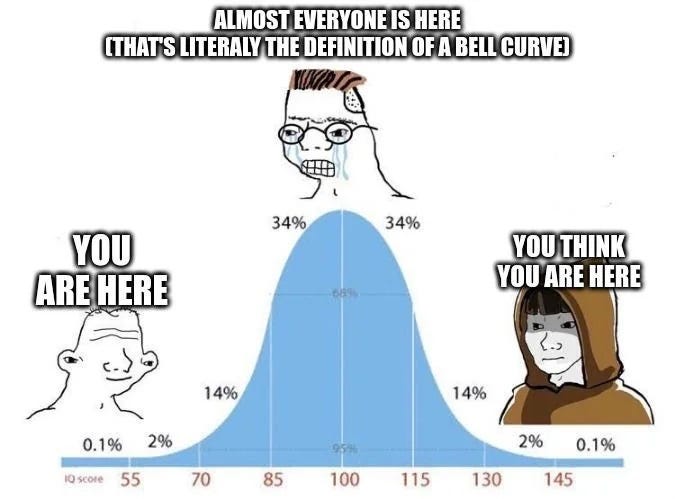
The long version
Why the ends agree
At the bottom there’s no theory, so you do the obvious thing. At the top there’s plenty of it, and you know what each piece costs, so you do the obvious thing again – with reasons this time. In between sits the person carrying just enough theory to feel obliged to use it.
The essay the test came from: Don’t Mid-Curve It.
The trap is that it feels like progress
You get here by learning things, which is supposed to help, and every step that got you here was a good one. Which is what makes it invisible from the inside.
Experts are wrong constantly, so wrongness can’t be the tell. What gives it away is complexity that flatters whoever deployed it. The quiz above bans “it depends” for that reason: true of almost everything, impossible to check, and it makes you sound careful.
The part I don’t enjoy
I built a quiz about this, which is a suspiciously mid-curve thing to do. The simple answer to “am I overcomplicating my life” is to ask someone who knows you. The far-end answer is probably to stop asking. I built a ten-question instrument with three editions and a scoring model.
Several of the questions are ones I’ve failed.
What is the midwit meme?
The midwit meme is a bell curve format where the low-IQ person and the high-IQ person agree on a simple answer, while the middle of the curve overcomplicates it. It took off on Twitter around 2020, after years of forum life before that.
What does midwit mean?
A midwit is someone smart enough to see complexity but not experienced enough to see through it. They know enough to identify problems but not enough to know which ones matter.
What is the midwit trap?
It’s the tendency to overcomplicate decisions that both beginners and experts handle simply. Beginners go with gut instinct because they haven’t seen enough to doubt it. Experts do the same, but only after they’ve internalized decades of complexity and come out the other side. The midwit sits in between – just enough knowledge to second-guess every instinct.
Is the bell curve meme based on real psychology?
Not really. The Dunning-Kruger effect (1999) is the usual citation, but it cuts the other way – low performers wildly overestimated, high performers slightly underestimated, and miscalibration shrank as skill rose.